
Table of Contents
Watch any AI coding demo and you’ll see something remarkable: a fully functional application materializing from a few natural language prompts. A database here, an API there, a polished UI. All generated in minutes. It looks like magic.
But here’s what those demos don’t show you: what happens when you try to scale that code. When you need to add a feature six months later. When security audits find vulnerabilities. When the system buckles under production load.
I call this the Prototype Illusion: AI-generated code that looks production-ready but isn’t. After spending nearly three years building AI applications and integrating LLMs into our product development workflow at Croxel, I’ve learned that this illusion is one of the most dangerous traps in modern software development.
This article introduces HAIC, the Human-AI Integrated Collaborative Framework, a methodology I developed to solve this problem.
The Problem: Three Ways AI Development Fails
Through my career in product development, and particularly through intensive work with AI tools over the past several years, I’ve identified three fundamental failure points that plague AI-assisted development:
Context Drift: The Amnesia Problem
LLMs operate within finite context windows. As your conversation progresses and fills with implementation details, the AI progressively “forgets” the strategic constraints you established early on. Requirements stated in message five get violated by code generated in message fifty.
The result? Code that locally optimizes for the immediate request while globally violating your foundational architectural decisions.
Probabilistic Execution: The Determinism Problem
Ask an AI to build a user service three times, and you’ll get three different implementations. While this variability can spark creativity during exploration, it becomes a serious liability during execution. Production systems require predictable, reproducible behavior. Unstructured AI interaction provides the exact opposite.
The Missing Middle: The Translation Gap
There’s a vast chasm between “Users need to pay via credit card” and the executable code that implements it. Traditional AI-assisted development asks the model to leap this gap in a single bound, forcing it to hallucinate the intermediate steps: architectural decisions, component boundaries, interface contracts, implementation sequences.
The AI makes invisible assumptions to fill this gap. Those assumptions are often shallow, incorrect, or misaligned with your actual business intent.

Why I Built HAIC
These problems aren’t theoretical for me. Over 10+ years of product development since founding Croxel, and particularly the past few years deeply immersed in AI application development, I’ve experienced every one of these failures firsthand. I’ve watched promising projects derail when AI-generated code couldn’t scale. I’ve seen teams waste weeks debugging “working” code that violated architectural patterns established at the start of the project.
But I’ve also seen what works. Through systematic experimentation (building multiple AI applications, testing different workflows, studying where LLMs excel and where they struggle) I developed HAIC to address these fundamental challenges.
HAIC stands for Human-AI Integrated Collaborative, a framework that transforms AI from an unpredictable coding assistant into a reliable engineering partner.
Early results from our internal pilot projects have been dramatic. We are seeing strong indicators that projects that traditionally required 8-12 months could be completed in 4-6 months, and teams of 4-6 engineers could potentially be replaced by focused teams of 1-3. And critically, the output in these tests is production-grade: maintainable, scalable, and architecturally sound.
HAIC’s Core Insight: Structure Over Capability
The key insight behind HAIC is counterintuitive: the problem isn’t that AI models lack capability. It’s that we lack structure.
We’ve been treating AI as a “magic box” that receives vague prompts and outputs products. That approach works for prototypes and throwaway scripts. It fails catastrophically for production systems.
HAIC imposes structure through three pillars.
The Three Pillars of HAIC
HAIC Pillar 1: Collaborative Progressive Decomposition
Instead of asking AI to leap from requirements to code, HAIC breaks the development process into 8 distinct layers of increasing granularity. Each layer takes the output of the previous layer and increases its resolution.
By the time the AI reaches the code generation layer, it’s not being asked to “design a system.” It’s being asked to write a specific block of code to satisfy a specific test case, defined in a specific step, belonging to a specific sub-task, mapped to a specific user story.
The cognitive load is removed from execution and front-loaded into planning, where humans excel.
HAIC Pillar 2: The Leadership Gradient
HAIC recognizes that human and AI strengths are inversely correlated across the development lifecycle:
- Humans excel at: Ambiguity resolution, strategic thinking, business value judgment
- AI excels at: Pattern recognition, syntax generation, speed at scale
Rather than fighting this reality, HAIC embraces it through what I call the Leadership Gradient: a systematic transition of leadership from human to AI as work becomes more concrete.
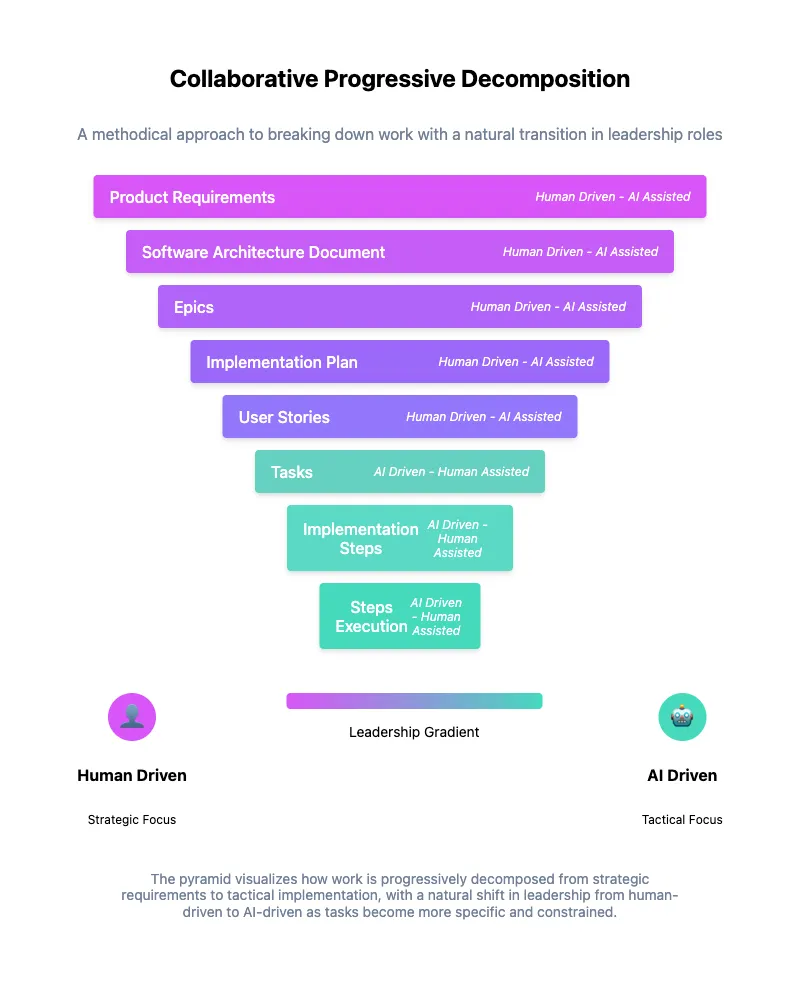
Strategic Phase (Layers 1-5): Human Driven, AI Assisted
In the upper layers, humans create the vision, make architectural choices, and define what “done” looks like. AI acts as a force multiplier: drafting documents, checking consistency, generating edge cases.
Key Dynamic: AI suggests; Human decides.
Tactical Phase (Layers 6-8): AI Driven, Human Assisted
In the lower layers, AI takes the lead. It decomposes stories into sub-tasks, plans implementation steps, writes tests, and generates code. Humans supervise: reviewing plans, unblocking obstacles, performing final verification.
Key Dynamic: AI executes; Human verifies.
HAIC Pillar 3: The Golden Thread
Every piece of code in a HAIC project must justify its existence by pointing to a parent definition. If code can’t trace its lineage back to a business requirement, it’s considered unauthorized scope. By definition, a hallucination.
This unbroken chain of traceability, from requirement to architecture to epic to story to sub-task to code commit, creates what I call the Golden Thread.
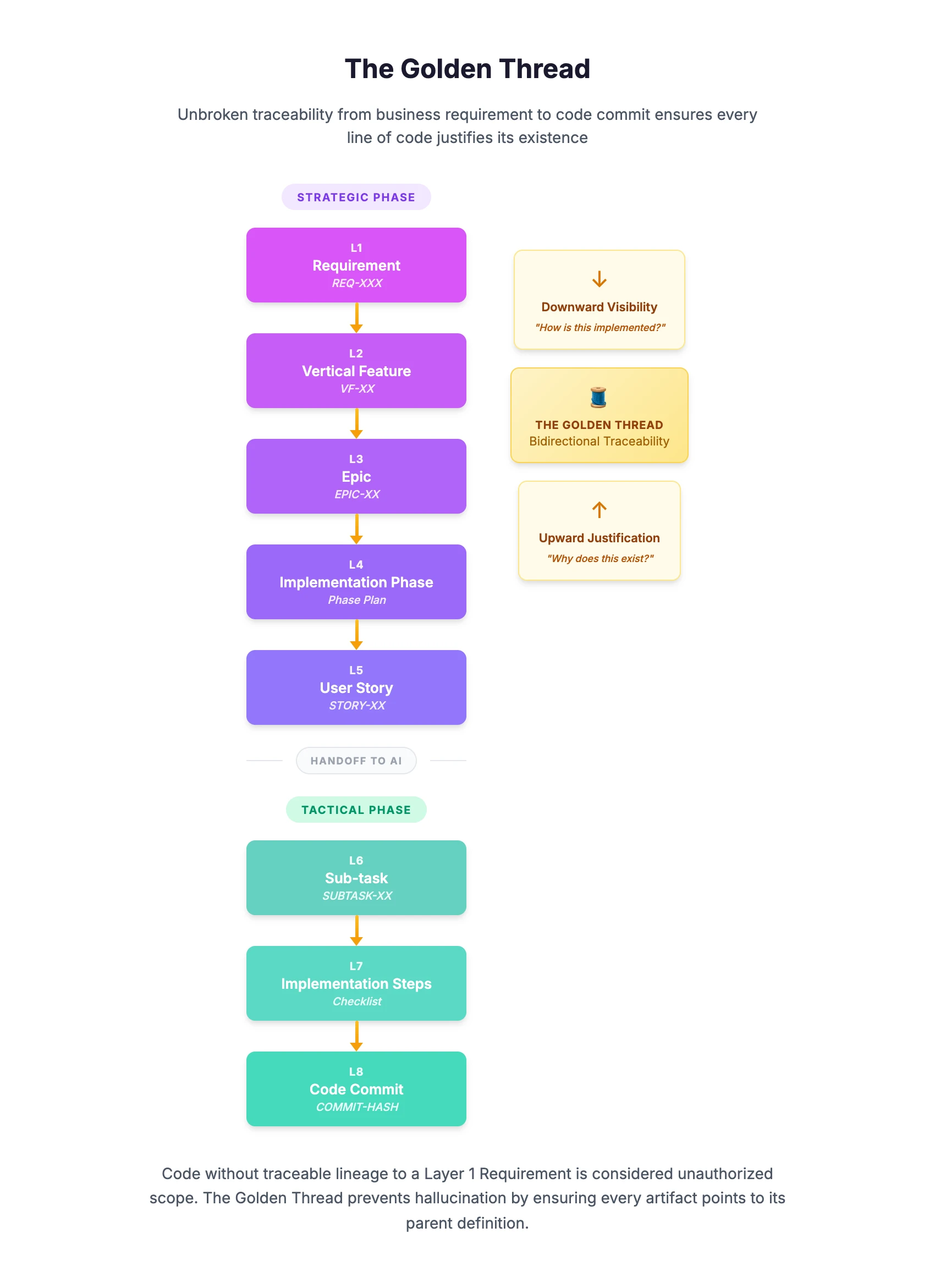
The Golden Thread doesn’t just enable auditing. It actively constrains the AI’s execution. When an agent operates at the code generation layer, it receives only the context of its parent sub-task, which references the parent story, which references the architecture. This recreates the focus of a senior engineer who knows what to work on, and equally important, what not to work on.
The HAIC 8-Layer Architecture
HAIC organizes work into two phases across eight layers:
Phase 1: Strategic Planning (Human Driven)
| Layer | Focus | Output |
|---|---|---|
| L1 | Product Requirements | PRD & Release Strategy |
| L2 | Software Architecture | System design & patterns |
| L3 | Epics | Deliverable feature chunks |
| L4 | Implementation Plan | Technical sequencing |
| L5 | User Stories | Testable value units |
Phase 2: Tactical Execution (AI Driven)
| Layer | Focus | Output |
|---|---|---|
| L6 | Sub-tasks | Technical components |
| L7 | Implementation Steps | Execution recipe |
| L8 | Code Execution | Tests & commits |
Layer 5 marks the handoff point. Stories completed there are ready for AI-driven tactical execution.
When to Use HAIC
HAIC isn’t for every situation. If you’re building a throwaway script, a quick proof of concept, or validating an idea, just prompt and go. The overhead isn’t worth it.
But if you’re building a system that needs to:
- Scale beyond the initial implementation
- Be maintained by teams over time
- Meet production reliability requirements
- Pass security and compliance audits
- Evolve with changing business needs
Then HAIC provides the structure that transforms AI from an unpredictable coding assistant into a reliable engineering partner.
The HAIC Initiative at Croxel
This framework is born out of our decades of experience delivering complex, production-grade software. While we recognize the immense potential of generative AI, our assessment of the current technical landscape is that unstructured AI usage simply isn’t ready for the rigorous demands of serious product development.
That’s why we began developing HAIC.
Currently, HAIC is an active research and development initiative within Croxel. We are engaged in rigorous internal testing, using selected pilot projects to iterate on the 8-layer structure and optimize human-AI workflows based on real-world friction.
We are systematically tackling the reliability problems that plague AI-assisted development. Our goal is to perfect these structures internally, ensuring that when applied to areas like IoT, firmware, or full-stack applications, they yield speed without compromising architectural integrity.
We believe production-grade AI development is not about smarter models. It’s about smarter structure, and that is the future we are actively building.
For the complete HAIC methodology including detailed layer specifications, implementation guidance, and operational templates, download the HAIC Framework White Paper.
Related Topics
About the Author

Albert Garvett
CEO & Co-Founder
Electrical Engineer with 25+ years of experience in business management and product development. Leads Croxel's strategic vision and product development initiatives, applying results-oriented methodologies to guide high-performance engineering teams. Expert in transforming complex IoT concepts into market-ready solutions across diverse industries.
Albert Garvett has written 5 articles for Croxel Insights.