
Table of Contents
For decades, elevator alignment safety has shared the same vulnerability across vendors and systems: the leveling sensors are mounted in the shaft, where the reference geometry simply cannot stay stable over time. Buildings settle. Components vibrate. Routine service operations introduce small displacements. Over years of operation, those small displacements add up, and the elevator car begins to come to rest above or below the floor landing. The result is a recurring source of trip and fall hazards for passengers and technicians, and a recurring source of injury claims and litigation across the elevator industry.
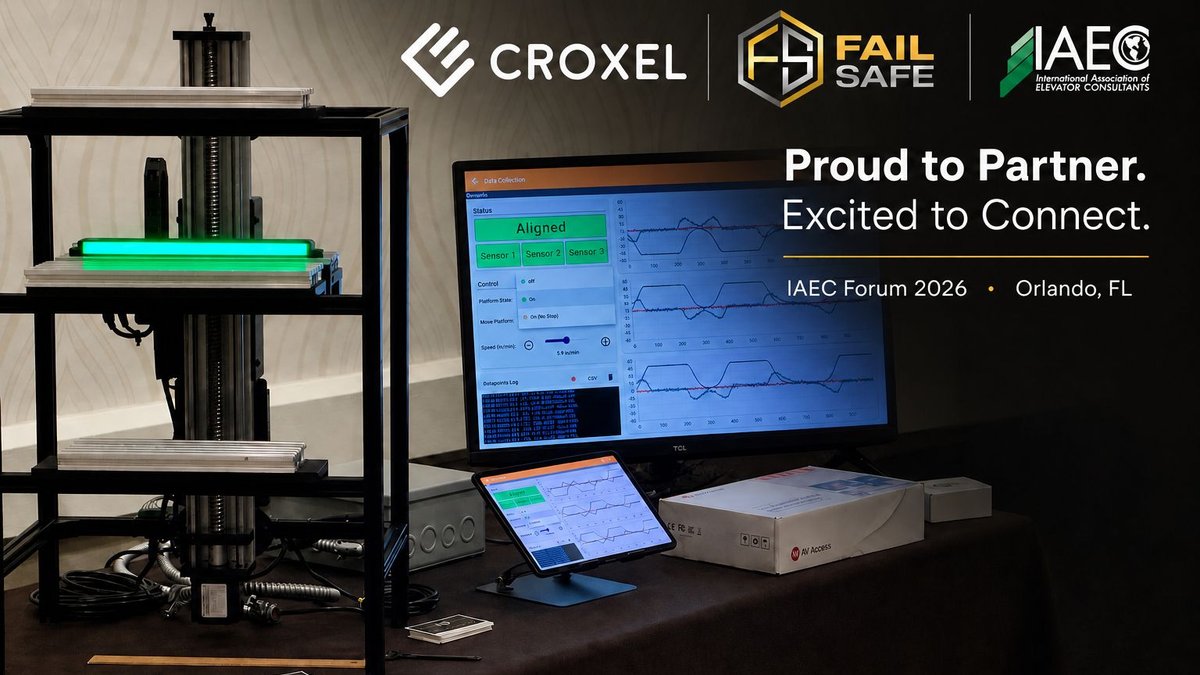
This week at the International Association of Elevator Consultants (IAEC) Forum 2026 in Orlando, Fail Safe Elevator Systems, Inc. is launching a different approach to that problem—one that anchors the alignment reference to concrete instead of the shaft, and pairs it with AI-assisted pattern-recognition detection. Croxel served as the engineering partner for the launch, carrying the system from initial proof of concept through engineering validation to a production-ready product on the show floor.
The Partnership
The FailSafe Alignment System is the flagship product of Fail Safe Elevator Systems, Inc., a Delaware C-Corporation founded in late 2025 specifically to commercialize this approach. The company brings together decades of elevator industry experience and the engineering discipline required to take a safety-critical product to market.
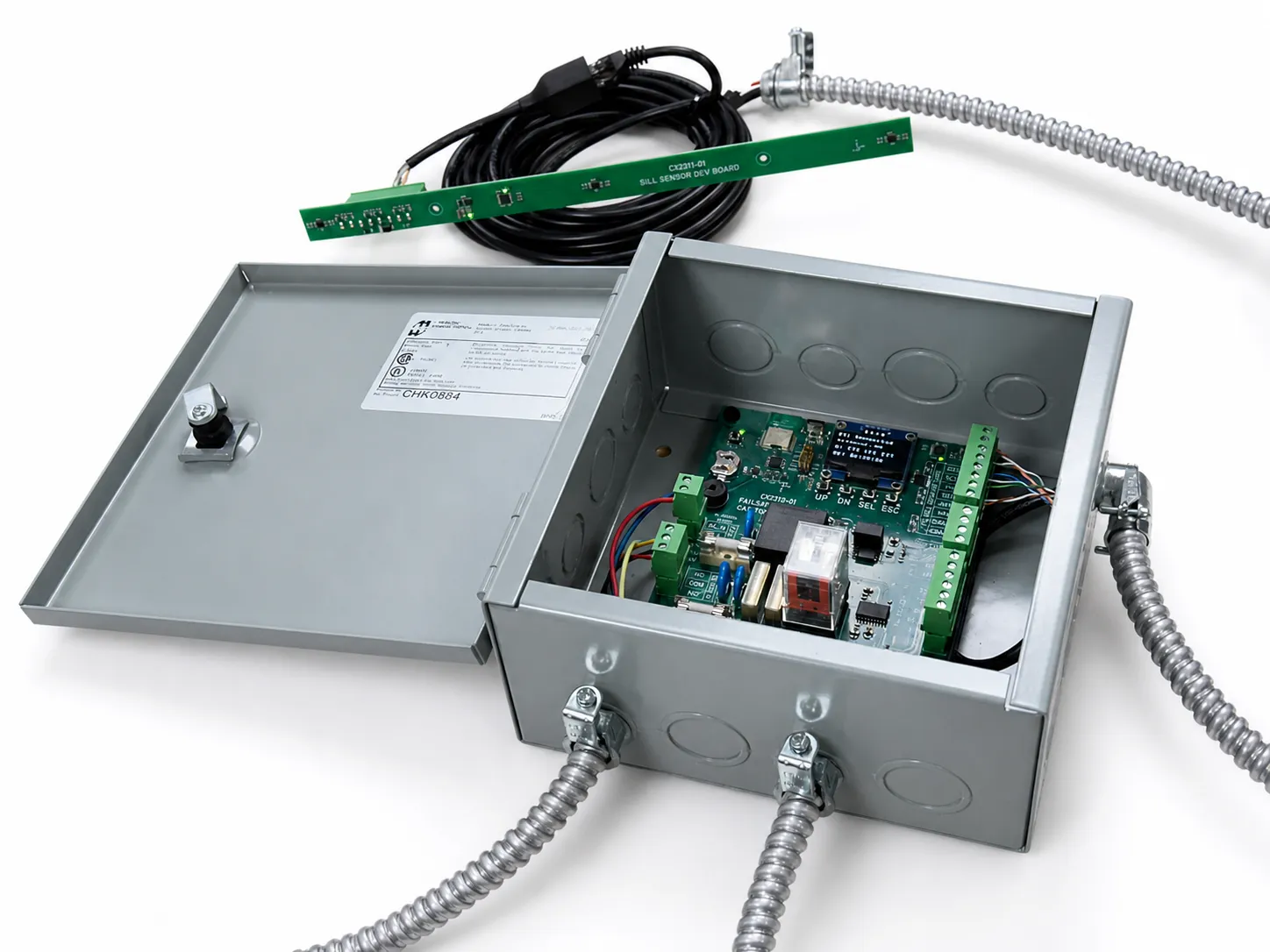
Croxel’s role in the partnership is the engineering implementation: hardware design, firmware architecture, mobile application, and field validation—the work that turns an idea into a product that consultants and service contractors can install and trust.
“The architectural shift from shaft-mounted to sill-mounted is the core innovation,” says Albert Garvett, Co-Founder and Chief Development Officer of Fail Safe Elevator Systems and Co-Founder and CEO of Croxel. “By anchoring the alignment reference to concrete instead of the shaft, we eliminate the drift mechanism that has plagued conventional systems. AI-assisted pattern recognition with built-in redundancy adds the robustness the elevator industry needs against real-world interference and component variation.”
The Architectural Shift
The starting point is the door sill. Unlike the elevator shaft, which moves with the building, the sill is fixed in concrete at each floor. By installing the sensor array directly in the sill, the alignment reference inherits the stability of the floor itself. The drift mechanism that causes shaft-mounted systems to fail isn’t mitigated. It’s eliminated by construction.
This is a reframing of the problem more than a refinement of an existing approach. Traditional shaft-mounted systems are reliable when first installed and unreliable years later. The FailSafe approach is reliable for the same reason a properly poured floor is flat: the geometry is anchored to something that doesn’t move.
AI-Assisted Detection
Reframing the reference geometry solves the drift problem. The detection algorithm is what makes the system robust against the messy realities of field deployment—electromagnetic interference from elevator structures and moving components, variation in installation tolerance, and the kinds of edge cases that aren’t visible in a lab.
The algorithm at the heart of the system is an AI-assisted pattern-recognition design. Rather than asking “did the signal cross threshold X?”—the question that traditional threshold-based detection has been asking for decades—it asks “does the full signal shape match the expected alignment signature?” That’s a fundamentally different question, and the answer is more robust to the perturbations that break threshold-based approaches.
Combined with multi-sensor redundancy and hysteresis-based deassertion that complies with elevator industry safety code, the system handles real-world conditions gracefully where threshold-based approaches fail sharply.
Built for Retrofit
A safety improvement that requires replacing the elevator controller is, in practice, not a safety improvement most operators will adopt. The FailSafe Alignment System was designed from the start for retrofit deployment. The car-top control board uses standard, non-proprietary controller interfaces, so the system can be installed alongside the elevator controllers already in service today—no controller-specific modifications required.
This was a non-negotiable design constraint. The elevator industry has hundreds of thousands of installations in the United States, and the path to industry-wide safety improvement runs through retrofit, not through wholesale infrastructure replacement.
Engineering the Product
The journey from concept to product launch was carried out across more than fourteen documented sprint iterations between September 2025 and April 2026.
- Proof of Concept (Sept–Oct 2025). The first iteration of the pattern-recognition algorithm established the technical viability of the sill-mounted approach. The result wasn’t just “it works”—it was the demonstration that this class of detection could be made robust enough for safety-critical operation.
- Engineering Validation Test (Jan–Apr 2026). Custom hardware was designed, fabricated, and validated. The algorithm was extended to multi-sensor operation. Mobile application and firmware were optimized for the realities of field installation. Performance was characterized at the platform speeds operators actually encounter on the floor.
- Product Launch (May 5–7, 2026). The system is on display at the IAEC Forum 2026 in Orlando, with live demonstrations available at the Fail Safe Elevator Systems exhibit.
At IAEC Forum 2026
The IAEC Forum is the recognized industry event for the elevator consultant community in the United States. For an elevator-safety product, this is the launch venue—the audience that influences specification decisions across the country. The team is on the show floor through May 7, walking consultants through the architecture, running live demonstrations of the system, and starting the conversations that turn a product launch into industry deployment.
If you’re at IAEC 2026, find us at the Fail Safe Elevator Systems booth. The demo is worth a few minutes.
Looking Ahead
The launch is the beginning of the work, not the end of it. Post-IAEC, the focus shifts to engagement with elevator consultants, service contractors, and OEM partners; iteration on the product based on field feedback; and the gradual buildout of the retrofit footprint that turns a better safety architecture into a measurable industry improvement.
For Croxel, this is also a continuation of a broader pattern: applying our IoT and embedded-systems engineering capabilities to safety-critical and infrastructure-critical applications where the engineering rigor matters as much as the underlying idea. Elevator safety is a category where that combination is especially load-bearing.
We’re proud of the work, proud of the partnership, and proud of where it leads.
Related Topics
About the Author

Albert Garvett
CEO & Co-Founder
Electrical Engineer with 25+ years of experience in business management and product development. Leads Croxel's strategic vision and product development initiatives, applying results-oriented methodologies to guide high-performance engineering teams. Expert in transforming complex IoT concepts into market-ready solutions across diverse industries.
Albert Garvett has written 5 articles for Croxel Insights.